The Complete Guide to Tilapia Mouthbrooding and Egg Care
For fish farmers in Zambia looking to scale up production and maximize hatchery survival rates, understanding tilapia breeding biology is essential. Tilapia are highly efficient breeders, largely thanks to a survival strategy known as mouthbrooding.
This comprehensive guide breaks down how mouthbrooding works, how to identify brooding females, and how to care for tilapia eggs to ensure high survival rates in your hatchery.
1. What is Tilapia Mouthbrooding?
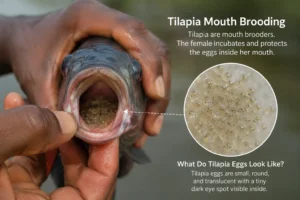
In commercially farmed tilapia—such as the Nile Tilapia (Oreochromis niloticus) and Three-Spotted Tilapia (Oreochromis andersonii)—this responsibility falls entirely on the female. This is known as maternal mouthbrooding.
The Mouthbrooding Cycle:
- Courtship & Spawning: The male digs a nest in the pond bottom and courts the female. The female lays her eggs in the nest, and the male immediately fertilizes them.
- Egg Collection: Within seconds of fertilization, the female picks up the eggs into her mouth.
- Incubation: She carries the eggs for 10 to 14 days, constantly churning them in her mouth to keep them oxygenated and clean from fungus.
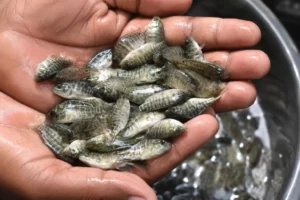
- Release: Once the yolk sacs are absorbed and the fry can swim freely, she releases them into shallow waters, though they may rush back into her mouth if danger approaches.
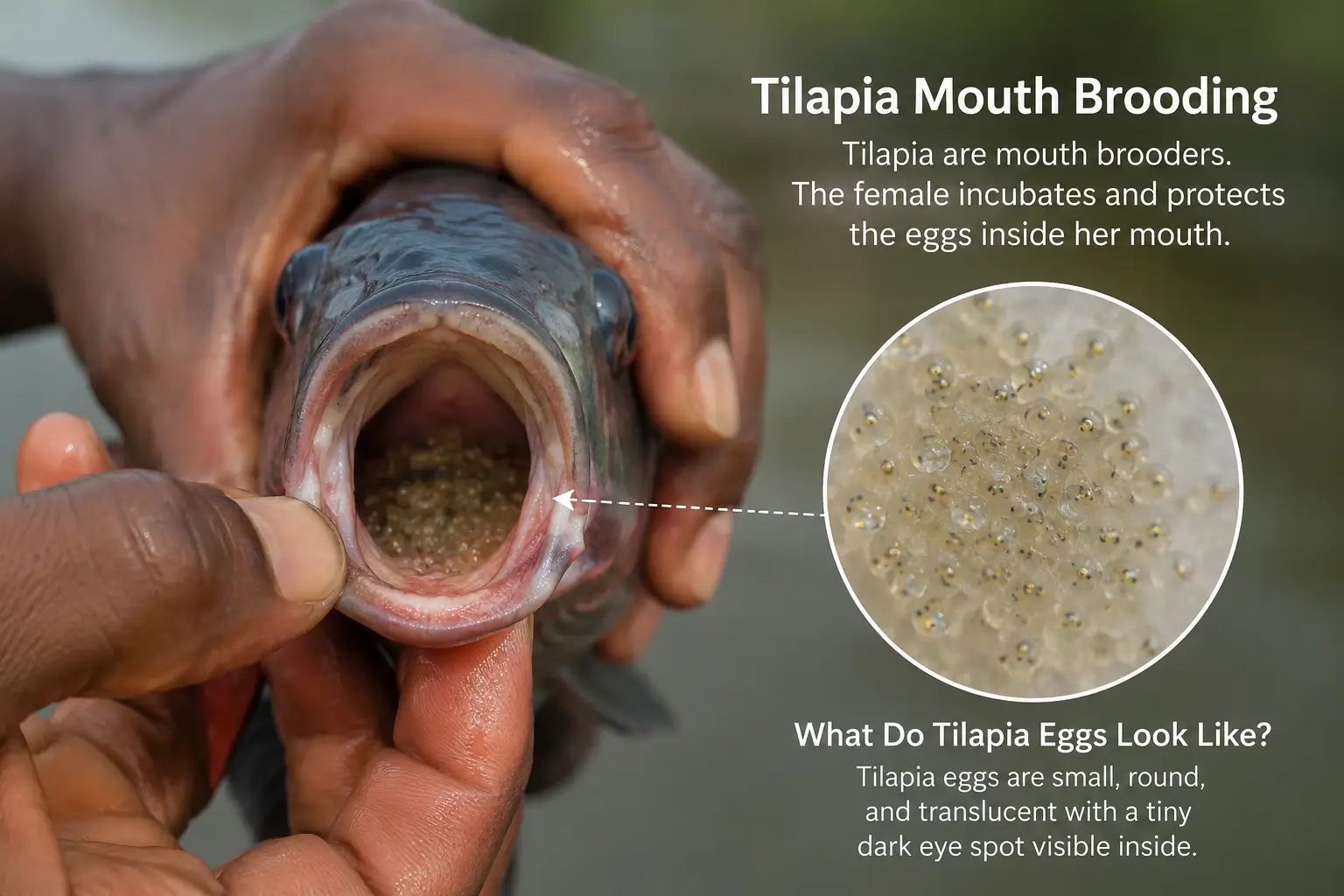
2. Identification: What Do Tilapia Eggs Look Like?
| Characteristic | Description |
|---|---|
| Shape | Distinctly oval or egg-shaped (not perfectly spherical). |
| Size | Small, usually measuring between 2mm to 4mm in length. |
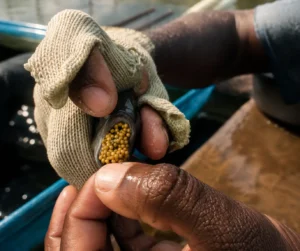
| Color (Freshly Laid) | Yellowish-brown, amber, or pale orange. |
| Color (Developing) | Darkens over time; you will eventually see two tiny black dots (the eyes of the developing embryo). |
How to Spot a Brooding Female in Your Pond
- Distended Throat: Her lower jaw and throat area (buccal cavity) will look swollen or dropped, resembling a pouch.
- Rapid Churning Movements: You will see her throat moving in a rhythmic, pumping motion. She is moving the eggs to ensure they all receive oxygen.
- Isolating Behavior: She will swim away from the main school, often hiding near the edges of the hapa or pond.
- Refusal to Feed: She will ignore floating pellets during feeding time to prevent swallowing her brood.
3. Expert Tilapia Egg Care & Hatchery Tips
- Harvest Weekly: Seine your breeding hapas every 7 to 10 days to collect brooding females.
- Gentle Stripping: Hold the female underwater, gently pry her lower jaw open, and move her backward and forward in a clean bucket of water to let the eggs fall out.
- Sort by Stage: Separate unhatched eggs from hatched larvae with yolk sacs.
- Optimize Water Flow: Place unhatched eggs into your incubator. Keep a continuous, gentle upward water flow. The flow must be strong enough to keep the eggs suspended and tumbling smoothly, but not so aggressive that it cracks the delicate egg shells.
- Maintain Ideal Temperatures: Keep hatchery water between 26°C and 30°C. Lower temperatures (common in Zambian winters between June and July) can double incubation times or cause egg mortality.
- Broodstock Conditioning & Spawning: Mature male and female tilapia are placed together in specialized enclosures, often fine-mesh net cages called hapas, within ponds or tanks. These allow for easy monitoring. The fish are conditioned with high-quality feed and an optimal environment—temperatures ideally between 27–29°C (80–84°F) to trigger spawning.
- Identification of “Holding” Females: After a spawning cycle of about 5–14 days, trained staff carefully examine the females. A female incubating eggs in her mouth is said to be “holding.” Technicians can spot her by her slightly distended buccal cavity and characteristic behavior.
- The Gentle Extraction: This is the critical moment. A female is gently but firmly held. With practiced care, the technician opens her mouth and rinses or gently shakes the mass of fertilized eggs—often numbering in the hundreds—into a container of clean water. The goal is to retrieve the developing embryos without harming the mother. The entire process, when done correctly, is remarkably stress-free for the fish.
- Egg Sorting and Disinfection: The collected eggs are examined. Skilled technicians can estimate their age by color: freshly fertilized eggs are a vibrant light yellow, while more developed eggs turn a dark orange or brown. Eggs of a similar developmental stage are grouped together and often given a brief disinfectant bath to prevent fungal and bacterial issues.
- Artificial Incubation: This is where the real magic happens. The eggs are transferred to specialized upwelling incubators—often clear, round-bottomed jars. A constant, gentle flow of clean, high-quality water keeps the eggs in a slow, tumbling motion, mimicking the churning action of the mother’s mouth and preventing them from clumping.
Google-Optimized FAQ Section
Yes, the vast majority of commercially cultured tilapia species are maternal mouthbrooders. The females actively protect their eggs and fry inside their mouths until the young are strong enough to survive on their own.
Inside the mouth, tilapia eggs appear as a dense mass of small, oval, amber-colored beads. As they mature, the cluster shifts to a darker color as the eyes and tails of the fry develop.
Absolutely. Stripping eggs from the female and moving them to a clean hatching system with a continuous water flow improves survival rates up to 90% and allows the female fish to spawn again sooner.